Setting up a business in India often begins with a Private Limited Company — the most trusted structure for start-ups and growing companies.
Setting up a business in India often involves choosing a private limited company as a preferred option. This structure offers shareholders limited liability protection while placing specific ownership constraints. In contrast, in the case of an LLP, partners oversee the management. Private limited company registration in India allows for a clear distinction between directors and shareholders.
At Digiqore, we offer a cost-effective service to facilitate the seamless private limited company registration in India. We handle all legal formalities, ensuring strict compliance with the Ministry of Corporate Affairs (MCA) regulations.
In India, a private limited company is a privately held entity with limited liability, and it ranks among the nation's most favored business structures. This popularity is primarily attributed to its numerous advantages, including limited liability protection, ease of formation and maintenance, and its status as a distinct legal entity. A private limited company enjoys legal separation from its owners and necessitates a minimum of two members and two directors for its operation. Here are the key characteristics of a private limited company in India:
In summary, the attributes of a private limited company registration process in India make it a favored choice among entrepreneurs, owing to its advantageous features and relatively straightforward structure.
A Private Limited Company Incorporation is one of India's most popular business structures. It offers several advantages and some disadvantages, let us explain.
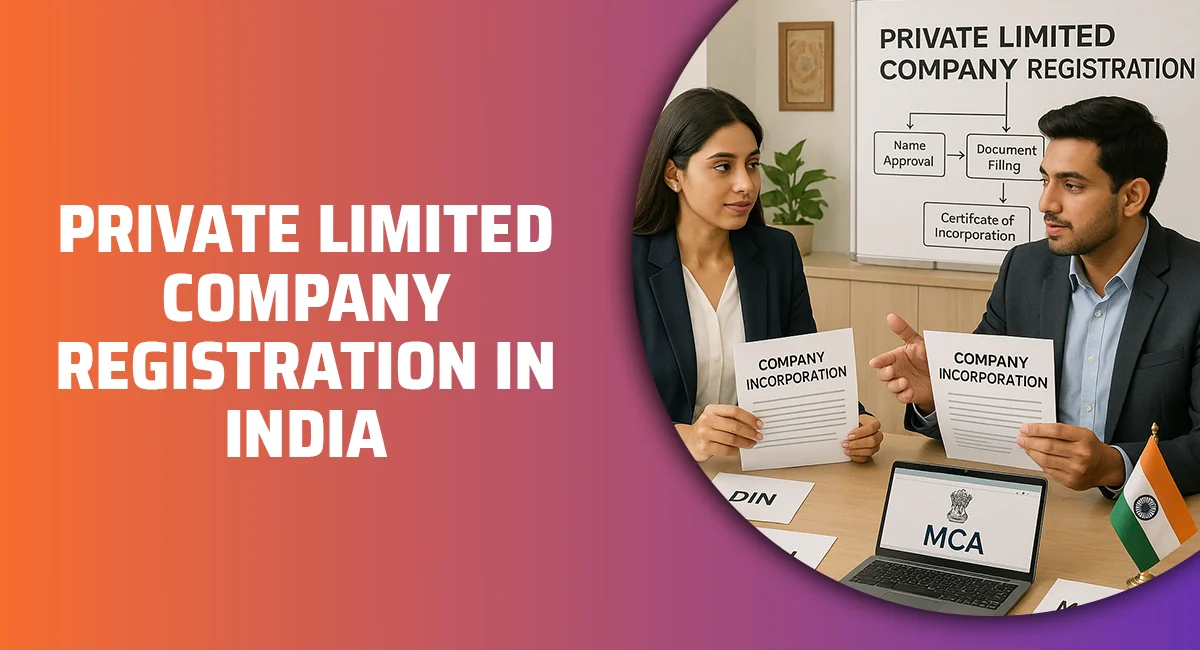
Registering a company in India involves a straightforward four-step company registration process:
Every director and shareholder must secure a Digital Signature Certificate (DSC) issued by the Controller of Certification Agencies (CCA). This involves providing essential details such as passport-sized photos, PAN, Aadhaar Card, phone number, and email address. Foreign nationals should also furnish notarized and apostilled documents if applicable.
Obtain a Director Identification Number (DIN) if you intend to be a director in the company. DIN is essential for directors and needs to be provided in the registration form.
Begin by completing the SPICe+ Part A form to secure a unique company name. This entails selecting the company type, class, category, and sub-category, specifying the primary division of industrial activity and offering a comprehensive business description. You'll need to propose two names for approval.
Provide comprehensive information concerning capital, registered office address, subscriber and directors' details, stamp duty, PAN and TAN application, and necessary attachments. Ensure compliance with the Companies Act 2013 and obtain digital signatures from assisting professionals.
Draft the Memorandum of Association (MOA) and Articles of Association (AOA) containing crucial company details. Obtain digital signatures from subscribers and professionals before submitting these documents to the MCA for approval.
Additionally, file the AGILE-PRO-S form to register for GST, EPFO, ESIC, a bank account, and a shop and establishment license (which may be state-dependent).
Upon successful document verification, the MCA will issue the Certificate of Incorporation (COI) with the Company Identification Number (CIN), PAN, and TAN.
Following incorporation, adhering to post-registration company compliances is essential to streamline company operations and define the roles and responsibilities of directors and shareholders.
A Public Limited Company can raise capital from the public and is ideal for large-scale b…
Learn more →A Limited Liability Partnership combines the flexibility of a partnership with the benefi…
Learn more →A Section 8 Company is a non-profit formed to promote charity, education, art, science or…
Learn more →An OPC lets a single entrepreneur enjoy the benefits of a company with limited liability …
Learn more →A Nidhi Company primarily deals with borrowing and lending among its members — a popular …
Learn more →The simplest way to start a business in India, owned and run by a single person with mini…
Learn more →Send us your requirement and our team will get back with a customised plan and pricing.
Request a Quote Contact Us