A Section 8 Company is a non-profit formed to promote charity, education, art, science or social welfare, with strong legal recognition.
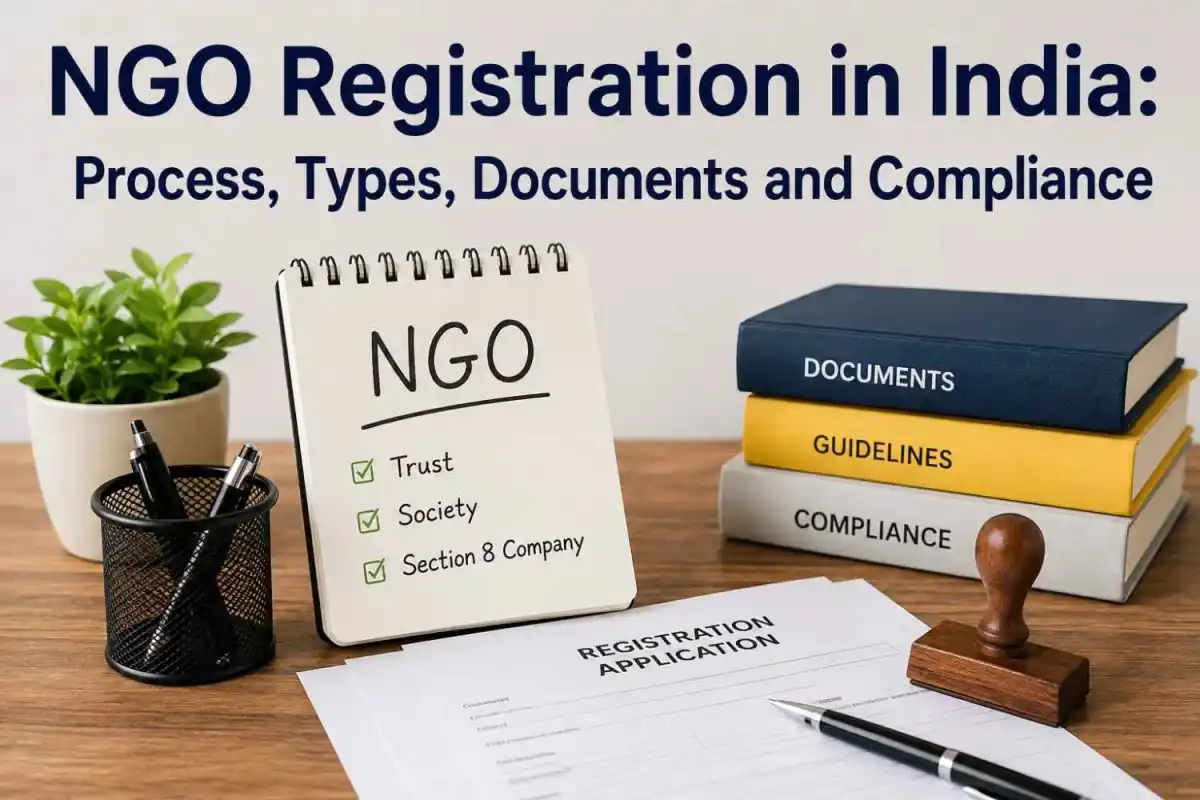
A Section 8 Company is a non-profit organization that aims to promote charitable activities, art, science, education, and sports. The profits of such companies are utilized for promoting these objectives and are not distributed among the Company's members. It is essential to understand what is Section 8 company, document requirements, and company incorporation process. Register your Section 8 Company NGO Registration Online under guidance of our Chartered Accountants (CAs) & Company Secretaries (CSs).
According to the Companies Act 2013, a Section 8 company is defined as an organization whose objectives are to promote arts, commerce, science, research, education, sports, charity, social welfare, religion, environmental protection, or other similar activities goals. These entities utilize their profits to achieve their mission and do not distribute dividends to their shareholders.
Following are the advantages of Section 8 Company Registration in India:
These types of companies in India are considered as a separate legal entity, which means that they can own property, sue or be sued in their name, and enter into contracts.
Due to its non-profit nature, Section 8 Companies are often viewed as more credible & trustworthy than other types of Companies.
These Companies are exempted from paying stamp duty on their Registration Documents.
These companies don't have any minimum capital requirement.
In India, Section 8 Companies do not have a minimum capital requirement and they can adjust their capital structure as per their growth and give them more flexibility.
Tax exemption is only allowed to the donations received by the Section 8 Company under Section 12A & 80G of the Income Tax Act.
Following is the eligibility criteria for Section 8 Company Registration in India:
Following are some vital requirements for Section 8 Company Registration:
For Section 8 Company Registration in India, a minimum of 2 Directors are required.
There is no minimum paid-up capital for the Registration of Section 8 Company. NGOs in India established as a Section 8 company need not use the words Private Limited or Limited in their name.
Section 8 Company is managed by the BoD (Board of Directors) as per AoA & MoA of the Company, unlike other Trusts that are handled by the Trustees as per the Trust Deed.
Section 8 Company needs to follow the Rules & Regulations prescribed under the Companies Act, 2013. It needs to file returns & maintain Books of Account with ROCs. Section 8 Company can't make any alterations to the provisions of Memorandum of Association (MoA) & Articles of Association (AoA) without prior consent of the Central Government and it should follow the provisions of the GST Law & Income Tax Act.
In India, Section 8 Companies are registered with non-profit objectives. The AoA & MoA must mention the purpose for which it is set up. Any profits earned by the Section 8 Company is utilised for the furtherance of its main objectives i.e., charitable purposes in the Company. The profits will not be distributed among its members.
DSC or Digital Signatures of all the proposed Company's Directors are necessary for the Registration because the forms for the Registration process are filed online & should be digitally signed. Apart from DSC, you need to apply for DIN for the Directors and the application for allotment of DIN must be filed in Form DIR-3 or along with the SPICe+ Form for the Registration.
Following are some crucial documents required for Registration of Section 8 Company:
Following is the step-by-step procedure for Section 8 Company Registration:
First, the applicant needs to obtain a Digital Signature Certificate of the proposed Directors. Once they receive DSC, file Form DIR-3 with ROC for obtaining DIN. The identity & address proof should be attached for getting DSC. Once DIR-3 is approved, the Registrar of Companies will allot a DIN to the proposed Directors.
After getting DSC and DIN, the next step is to file Form INC-12 with the Registrar of Companies to apply for a Licence under Section 8 Company along with the attachment of the required documents. Once the form is approved, a Licence under Section 8 Company will be issued in Form INC-16.
After getting License under Section 8, you need to file SPICe+ Form with the Registrar of Companies (ROC) for the Registration along with the vital documents.
Note: Once the Registrar of Companies is satisfied with the forms submitted, he or she issues a CoI (Certificate of Incorporation) along with a Unique CIN.
Following are the annual compliances for Section 8 Company:
As per the Companies Act, if the Company fails to comply with the legal provisions, then the Central Government will cancel the License for Section 8 Company. If the Company's objectives are conducted fraudulently or in violation of the objectives for which it is established, the licence can be cancelled. In case a Company fails to comply with the provisions of the Companies Act, then the Company will be punishable with a fine not less than Rs. 10 lakhs & may extend to Rs. 1 crore. The Officers & Directors of the Company in default of the provisions will be punishable with a fine not less than Rs. 25,000 which may extend to Rs. 25 lakhs or both.
Setting up a business in India often begins with a Private Limited Company — the most tru…
Learn more →A Public Limited Company can raise capital from the public and is ideal for large-scale b…
Learn more →A Limited Liability Partnership combines the flexibility of a partnership with the benefi…
Learn more →An OPC lets a single entrepreneur enjoy the benefits of a company with limited liability …
Learn more →A Nidhi Company primarily deals with borrowing and lending among its members — a popular …
Learn more →The simplest way to start a business in India, owned and run by a single person with mini…
Learn more →Send us your requirement and our team will get back with a customised plan and pricing.
Request a Quote Contact Us