
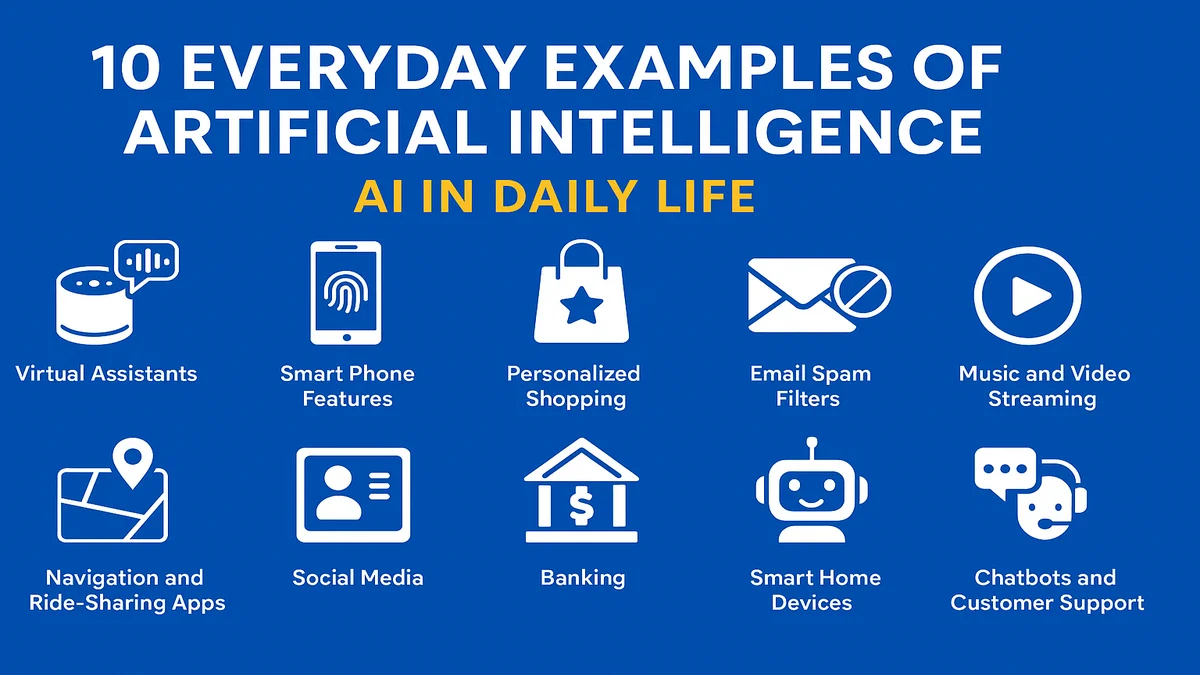
# AI in Daily Life: How Artificial Intelligence Is Making Everyday Tasks Easier
Artificial Intelligence (AI) is no longer just a futuristic idea from science fiction. Today, it has become a part of our everyday lives, often working quietly in the background. From the way we search for information to how we communicate, travel, shop, study, and entertain ourselves, AI is helping us complete tasks faster and more conveniently.
## 1. AI for Learning and Education
AI has made learning more personalized and accessible. Students can use AI-powered tools to understand difficult topics, summarize lessons, practice languages, generate study questions, and receive explanations based on their level of understanding.
For example, an AI assistant can explain a complicated science concept in simple language or help a student practice mathematics step by step. Teachers can also use AI to create lesson plans, quizzes, and educational materials.
However, AI should be used as a learning assistant rather than a replacement for thinking and understanding.
## 2. AI in Smartphones
Modern smartphones use AI in many ways. Voice assistants can answer questions, set reminders, send messages, and control smart devices. AI also improves phone cameras by recognizing scenes, adjusting lighting, reducing noise, and enhancing photos.
Features such as face recognition, predictive text, spam-call detection, and personalized recommendations also depend on AI technologies.
## 3. AI for Work and Productivity
AI can save time by helping people with routine tasks. It can draft emails, summarize documents, organize information, generate ideas, create presentations, and assist with data analysis.
For professionals, this means more time can be spent on creative thinking, decision-making, and tasks that require human judgment.
## 4. AI in Shopping
Online shopping platforms use AI to understand customer preferences and recommend products. When you see suggestions such as “You may also like” or “Recommended for you,” AI is often working behind the scenes.
AI can also help customers compare products, find information, and receive personalized recommendations.
## 5. AI in Transportation and Travel
AI is changing the way people travel. Navigation apps analyze traffic conditions and suggest efficient routes. Ride-sharing services use AI to match passengers with drivers and estimate arrival times.
AI is also being developed for advanced driver-assistance systems and autonomous vehicles, with the goal of making transportation safer and more efficient.
## 6. AI in Entertainment
Whether you are watching movies, listening to music, or scrolling through social media, AI helps personalize what you see and hear. Streaming services analyze viewing and listening habits to recommend content that may interest you.
AI can also help creators produce images, music, videos, and other forms of digital content.
## 7. AI in Healthcare
AI is increasingly being used to support healthcare professionals. It can help analyze medical images, organize patient information, identify patterns in health data, and assist with research.
AI does not replace doctors or other healthcare professionals, but it can provide useful tools that support diagnosis, research, and patient care.
## 8. AI at Home
Smart homes are another example of AI in daily life. Smart speakers, thermostats, security systems, and other connected devices can learn preferences and respond to voice commands.
For example, a smart system might adjust the temperature automatically or alert a homeowner when unusual activity is detected.
## The Importance of Using AI Responsibly
Although AI provides many benefits, it also comes with challenges. AI-generated information can sometimes be incorrect, and personal information should be handled carefully. People should verify important information and avoid sharing sensitive data with unknown AI services.
The best approach is to use AI as a helpful tool while keeping human judgment, creativity, and responsibility at the center.
## Conclusion
AI is already an important part of modern daily life. It helps us learn, communicate, work, travel, shop, and enjoy entertainment more efficiently. As AI continues to develop, its role in our everyday activities will likely become even greater.
The future of AI is not simply about machines doing everything for us. It is about **people using intelligent technology to work smarter, solve problems, and make everyday life more convenient**.